Urgent Garage Door Repair covers Sun City daily. Springs, openers, cables and doors off their tracks, same day where we can.
Tell us what the door is doing. No charge to come out, and nothing to pay if you decide against it.
A broken torsion spring is the fault we're called out for most often in Georgetown, and it's the one homeowners least expect. Nothing wears visibly, nothing sounds wrong, and then one morning the door won't lift and the car is shut in. Around Sun City and Downtown Square we see it concentrated in Sun City single-stories and newer Wolf Ranch builds, where hard sun and hail, and heavy use in Sun City's retirement homes.
The spring isn't what lifts the door. It's what cancels the door's weight. A double steel door weighs between 130 and 190 pounds, and an insulated one more. Wound tight, the spring stores almost exactly that much energy, so the door behaves as though it weighs nothing and a half-horsepower motor can move it. When the spring breaks, that cancellation disappears at once and the full weight lands on the opener, which isn't built to lift it.
Anywhere in Georgetown or Round Rock, Leander, Liberty Hill, Jarrell the visit and the written estimate cost nothing. If you decide not to go ahead after seeing the estimate, you owe nothing.
The sound is unmistakable if you were home for it. A single flat bang, like a heavy book dropped on a concrete floor. Most people are asleep when it happens, because the metal contracts as the garage cools overnight and that's when a spring at the end of its life gives up.
If any of that matches, a technician can diagnose it on site in about ten minutes. We don't guess at it down the phone, and we don't charge to look.
There's one job on a residential garage door that sends people to hospital, and this is it. The energy in a wound spring doesn't dissipate because the spring has broken - the remaining half is still loaded, and the set screws holding it are the only thing in the way. Undone without winding bars properly seated, that load leaves in a fraction of a second and takes fingers with it. Adjustable wrenches and screwdrivers are not winding bars.
The general rule with a door that has failed is to stop using it. Every extra cycle you put through a door with a broken counterbalance transfers load onto parts that were never meant to carry it, and the job gets bigger with each attempt.
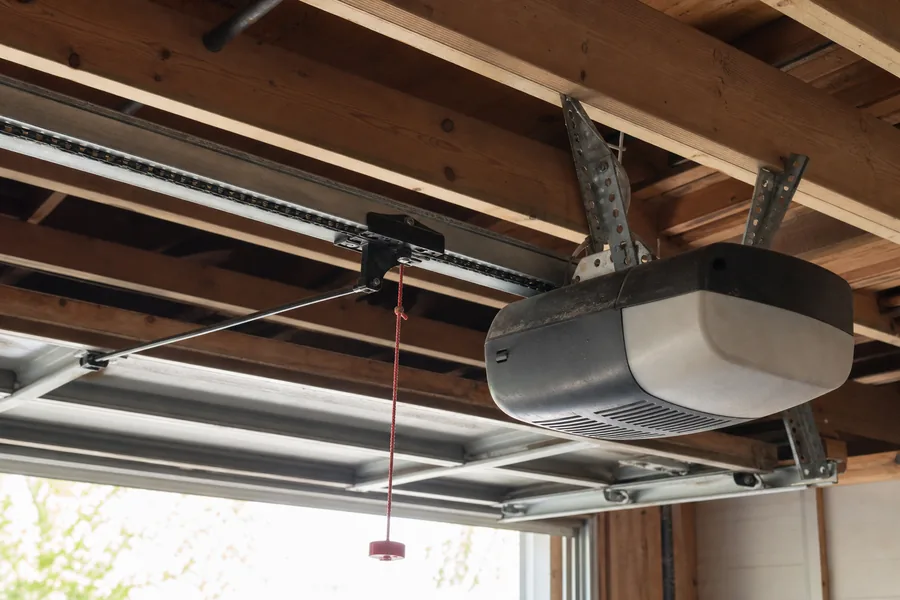
If you need the car out before we arrive, release the opener with the red cord only when the door is fully down, and lift with both hands and a straight back. If the door doesn't move easily, leave it. It's telling you the counterbalance is gone.
People put this off, and it is worth being straight about where that goes. None of the following is unusual. It's the ordinary sequence, and we see it in Georgetown every week.
The visit and the written estimate are free, so finding out where you stand costs you nothing at all. That is the whole reason to call early rather than late.
Almost every early failure we see in Georgetown traces to one of four things, and all four are within a homeowner's control.
An unbalanced door. If the spring isn't carrying the weight, the opener is, and the nylon gear inside it's the part designed to give way first. An opener that strains is an opener with months left.
Dry hardware. Hinges and rollers that have never been lubricated add drag to every cycle, and drag is spent cycle life. It's the difference between a spring reaching its rating and falling well short of it.
Ignored warnings. A frayed cable, a seized roller or a door that has started to sit crooked is a straightforward repair for a few weeks and a much larger one afterwards.
And forcing it. Every attempt to run a door that has already failed moves load onto parts that weren't designed to carry it.
Almost every residential door in Georgetown is standard torsion hardware, and standard hardware is what the van carries. Two exceptions come up often enough to be worth naming: Wayne Dalton's TorqueMaster, where the spring lives inside the tube, and the direct-drive European heads.
| Brand | Notes |
|---|---|
| Clopay | The most common door brand we work on. Panels, hinges and struts are orderable individually, so one damaged section doesn't mean a whole door. |
| Craftsman | Built on Chamberlain internals for most of their production run, so the gear kits and boards are shared and readily available. |
| LiftMaster / Chamberlain | The same units under two names. Gear kits, logic boards and Security+ 2.0 remotes are stocked, and the older 315MHz heads can still be paired. |
| Wayne Dalton | The TorqueMaster counterbalance is a spring inside the tube rather than on it, and it needs its own tools and its own parts. We carry them. |
| Genie | Screw-drive and belt-drive heads. Intellicode remotes and carriage assemblies are the usual failure points, and both are parts rather than a reason to change the opener. |
| Overhead Door / Raynor | Standard torsion hardware on the residential lines. Nothing unusual to source. |
The model number is usually on a sticker on the side or the back of the opener head, and on a plate inside the top section of the door. Read it out when you call and the van leaves with the right parts.
It almost never does. The spring is a consumable part on a door that lasts twenty to thirty years, and replacing it's a parts-and-labor job on a door that's otherwise sound. Anyone who leads with a replacement quote before looking at the panels is selling, not diagnosing.
You can, and we'll if that's what you want. But both springs were wound the same number of cycles on the same day, so the second one isn't far behind, and you pay the call-out and the labor twice. We quote both and let you choose with the numbers visible.
A spring that's too strong is as wrong as one that's too weak. The door creeps open on its own, the opener fights it on the way down, and the safety reversal stops working correctly. The spring is matched to the door's actual weight, not upgraded past it.
None of that is unique to Georgetown. It is simply what happens when a door is quoted over the phone by somebody who hasn't seen it, and it's the reason we don't give prices before a technician has stood in front of the door.
The difference between a job finished today and a job finished on Thursday is almost always whether the right part was on the van when it arrived. So the van is loaded for what Georgetown actually breaks rather than for a national average.
Springs in the common sizes, lift cables, drums, rollers, hinges, brackets, opener gear kits, remotes, safety sensors and weather seal all travel with the technician. Panels and complete doors are ordered, and we tell you that at the estimate rather than on the day.
It's also why the description you give on the phone matters. Tell us what the door is doing, what it sounds like, whether it's a single or a double and roughly how old it's, and the van leaves already carrying the answer.
Georgetown is the base and the surrounding towns are within the normal working radius. These are the areas the van is in most days:
Emergency and after-hours calls run to the same map. A door standing open overnight anywhere on that list gets somebody out.
Hard sun and hail, and heavy use in Sun City's retirement homes. Put that against a mechanism made of wound steel, galvanized cable and nylon bearings and the outcome isn't mysterious.
Corrosion is the quiet one. A spring that has picked up surface rust has lost section where the rust sits, and stress concentrates exactly there. It doesn't squeak or warn you. It simply fails earlier than its cycle count says it should.
Temperature is the loud one. Steel is a little less forgiving cold than warm, so a spring at the end of its life picks the coldest morning of the month to go. That is why the phone in Williamson County rings hardest before eight.
Neither is a reason to buy a different door. It's a reason to service the one you have before the season that will break it, and to size the replacement parts for Georgetown rather than for a catalog.

Georgetown covers Sun City and Downtown Square. Not a franchise territory drawn on a map somewhere else. The actual streets the van is on most days.
You get a two-hour arrival window rather than a day, and a call before the technician sets off. If we're going to be late you hear it from us first.
The visit is free, the written estimate is free, and nothing is agreed until you have seen it in writing. If you decide against it, that's the end of it.
Hard sun and hail, and heavy use in Sun City's retirement homes. Split by component, the effect is not evenly distributed:
| Part | What the local climate does to it |
|---|---|
| Torsion spring | Surface corrosion removes section, stress concentrates there, and the spring fails short of its cycle rating. |
| Lift cables | Rust starts at the bottom bracket end, closest to the floor, and works up the lay of the wire. |
| Rollers | Grit and moisture together destroy unsealed bearings; sealed nylon rollers are largely immune. |
| Bottom seal | Hardens, cracks, and stops sealing - after which the weather is inside the garage rather than outside it. |
| Opener | Suffers indirectly. Every one of the above makes the door heavier to move, and the nylon drive gear is what pays for it. |
None of it is exotic and none of it needs a special product. It needs looking at twice a year, which is the part most people in Georgetown skip.
Yes. Card, and everything is documented in writing. Nothing is cash-only and nothing is agreed on the doorstep without it in writing.
Yes - Round Rock, Leander, Liberty Hill, Jarrell and the wider Williamson County area are all inside our normal service radius.
Count the trips rather than the years and the failure stops looking random. One cycle is up and down once; the spring most builders fit is good for ten thousand of them. Two cars leaving and returning on a weekday is four cycles, plus the school run, plus the trash cans. Call it six. Six a day is 2,190 a year, which spends a ten-thousand-cycle spring in under five. Nothing has gone wrong when it breaks. It has simply been used up.
No. The visit and the written estimate are free anywhere in Williamson County. You pay only if you agree the price and we do the work.
Yes, in writing, on parts and labor. If the same fault returns inside the warranty period we come back and put it right at no charge.
If a spring or cable has failed, no. Leave it down and don't force it. The counterbalance holds a great deal of stored energy and it can let go without warning.
One call gets you a two-hour arrival window rather than a day, and a technician who rings before setting off. No lead auction, no bidding, no stranger quoting your door by phone.
Free visit, free written estimate, fixed price agreed before anything is touched. Throughout Georgetown and Round Rock, Leander, Liberty Hill, Jarrell.