The learn button, the thirty-second window, and the four things that stop a remote pairing. Written for the openers we see around Georgetown.
Give us the problem. Free estimate, no catch.
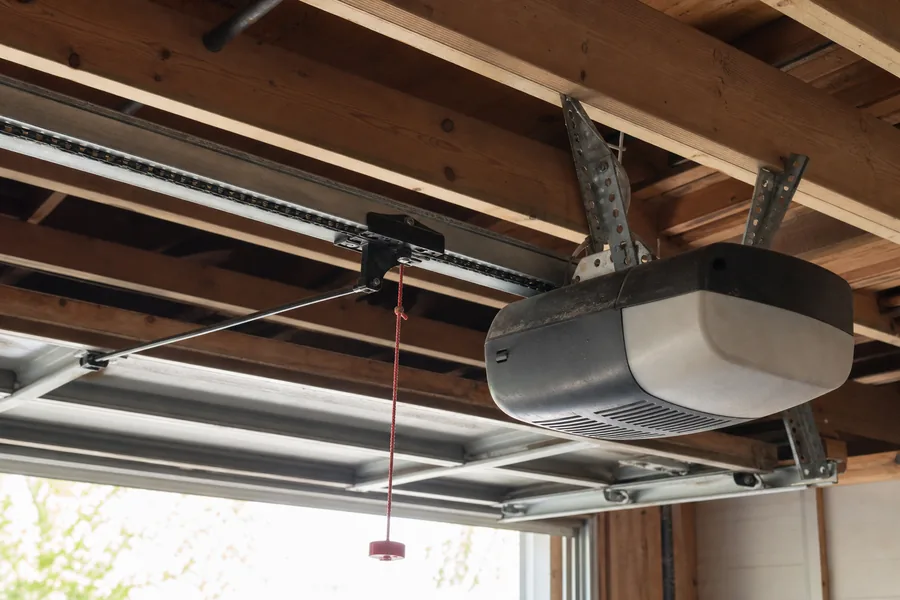
On the motor housing, near the thin antenna wire, is a small square button marked Learn. Press it once and for roughly thirty seconds the opener will accept whatever you press next: a remote, a keypad code, the button in your car. Everything below is that one move in different clothes.
Note the button's color before buying a remote. Yellow means the current Chamberlain and LiftMaster system; purple, red and orange are earlier generations of the same family, and a remote for one won't pair with another. Genie uses a black or blue button marked Learn Code. Around Georgetown the older purple-button units are still common in houses built before 2010.
Check the remote's battery before anything else; a coin cell that has been in a drawer for two winters is usually the whole problem.
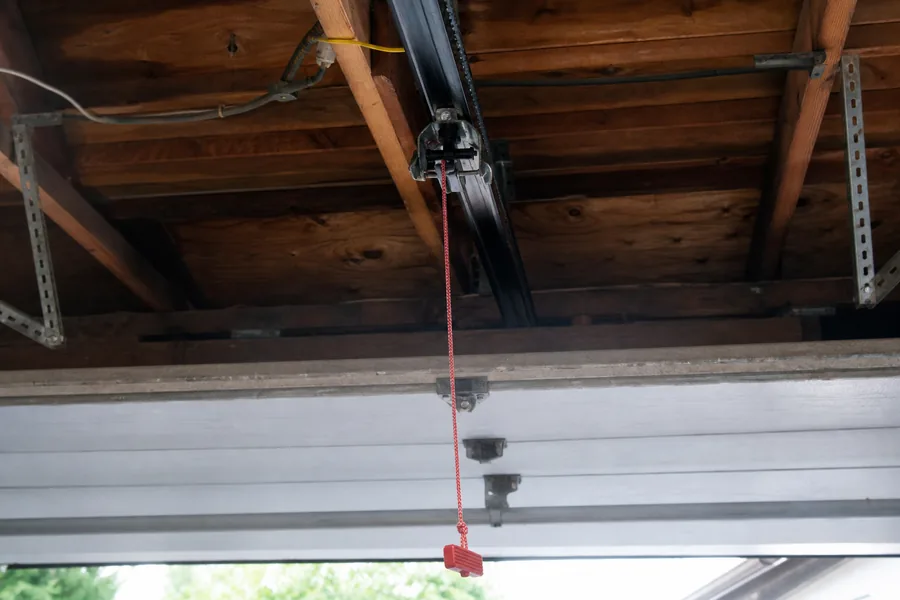
The keypad is the remote with a code in front of it; same window, one more step.
HomeLink is the set of three buttons on the visor or mirror in most cars sold since the mid-2000s. It learns from your existing remote first, then from the opener.
Step one is in the car: hold the HomeLink button and the remote a few inches apart until the indicator goes from a slow blink to a fast one. Step two is at the opener: press learn, walk back, and press the HomeLink button in two-second presses until the door moves. Rolling-code openers need step two; old fixed-code units stop at step one.
A few makes want the ignition on and take several tries. Keep going; it isn't the opener.
Hold the learn button down for six to ten seconds and the LED goes out: every paired device is gone. Do it when you move in, when a remote goes missing, or when a new remote won't take and the opener is old enough to have a full memory. Older units hold only a few devices.
Everything then needs re-teaching, keypad and car included; allow ten minutes.
Wrong generation. A remote made for a yellow-button opener will not pair with a purple-button one, and vice versa. The remote's packaging or the color band on it says which it fits. Universal remotes cover most generations and are the easy fix.
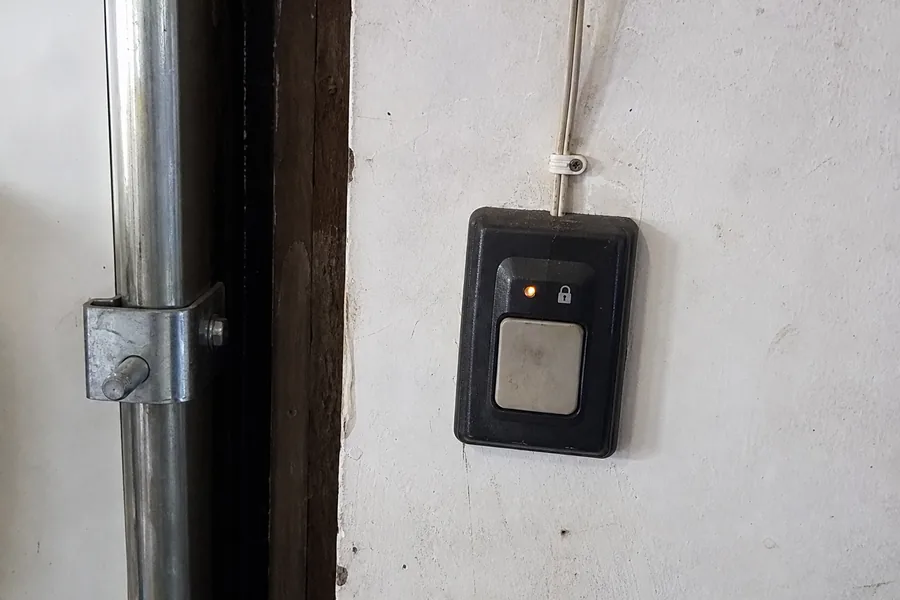
The lock is on. Wall controls on LiftMaster and Chamberlain have a lock or vacation button. With it engaged, remotes are ignored entirely, and the wall button's light blinks. Press and hold the lock button for two seconds to release it.
Memory full. See above. Clear and re-teach.
Dead battery, or the wrong one. Coin cells in remotes lose charge quietly. A remote that works at the door but not from the driveway is nearly always a battery.
Interference. LED bulbs in the opener's own light socket are a known source. If pairing only works with the light off, that's the bulb; swap it for one marked as garage-door compatible.
The receiver board. If the learn LED never lights, the opener won't take a remote at all and the logic board or receiver has failed. That's a repair, not a programming problem.
Chamberlain and LiftMaster. On the back or side of the motor housing, beside the antenna wire; on some models, behind the light lens. Square button, colored yellow, purple, red or orange. Newer Wi-Fi units also pair through the myQ app, but the physical button still works.
Genie. On the back of the motor head or under a small flap on the housing, marked Learn Code or Program. Genie's pairing wants the remote button pressed several times in quick succession rather than held.
Linear, Marantec and the rest. Same principle, different location. The manual is usually online under the model number printed on the housing label; a photo of the label is enough for us to find it if you'd rather not.
Most people get this done from the page. If two tries have gone nowhere, it's usually a generation mismatch, the lock setting or a receiver board, all of which a technician sorts in one short visit anywhere in Williamson County. Universal remotes and keypads ride along; a dead receiver gets named on site, not guessed at over the phone.
The visit includes a balance check on the door, because an opener straining against a tired spring is often the one with the flaky receiver.
You need the original remote to add a new one. No. The learn button on the opener pairs any compatible remote; the old one is irrelevant.
Universal remotes don't work with rolling code. Current ones do, across all the common generations. It's the very old fixed-code openers they sometimes can't reach.
If the remote won't pair the opener is finished. Almost never. Ten minutes of the list above finds the cause most of the time, and a receiver board is a repair, not a replacement.
Look on the motor housing near where the thin antenna wire hangs, or behind the light cover. It's a small square button, colored on Chamberlain and LiftMaster, black or blue on Genie.
That's range, not pairing: a weak battery, or an LED bulb in the opener interfering. Try the battery first.
On the Wi-Fi units, yes, and it's often easier. The physical learn button still works on those models if the app won't connect.
The lock feature is on. Press and hold the lock button on the wall control for about two seconds; the light stops blinking and the remotes work again.
Free, across Williamson County. If the opener needs a part, you hear what and why before anything is done.
Most days, yes. A remote or keypad job takes a few minutes on site.
One call, a two-hour window, and a call ahead from the technician. That's the routine across Georgetown, Downtown Square and Round Rock.
Free estimate. Throughout Williamson County, including Sun City, Downtown Square, Berry Creek, Round Rock, Leander, Liberty Hill, Jarrell.
We give a two-hour window rather than a day, and we call before setting off. Free throughout Williamson County. The estimate is free either way.
Prefer a voice? Call (512) 642-5436.
Give us the problem. Free estimate, no catch.