Retail shops, auto bays, storage facilities and warehouses along the growing corridors north of Austin all count on doors that open on time and lock at night. Urgent Garage Door Repair fixes the overhead, rolling and roll-up doors those businesses run on, and every job starts with a free estimate, no catch.
Give us the problem. Free estimate, no catch.
For a business, the big door is the shop. It lets the cars into the service bay, the pallets onto the floor and the customers' belongings into their storage units, and at the end of the day it is the lock between the street and everything inside. When it sticks, the work stops with it.
That is why commercial calls are ranked by what is at stake. A door that can't be secured comes first. A door that still works but grinds, shakes or hesitates is scheduled before it turns into the first kind, at a time that suits the way your business runs.
Most business openings carry one of three door types. The sectional overhead door is a bigger, heavier version of a house door, hinged panels on rollers in a track, often insulated and sometimes with a row of windows. The rolling steel door is a curtain of narrow slats that wraps onto a drum above the opening, counterbalanced by springs hidden inside that drum, with the curtain's ends held in vertical channels.
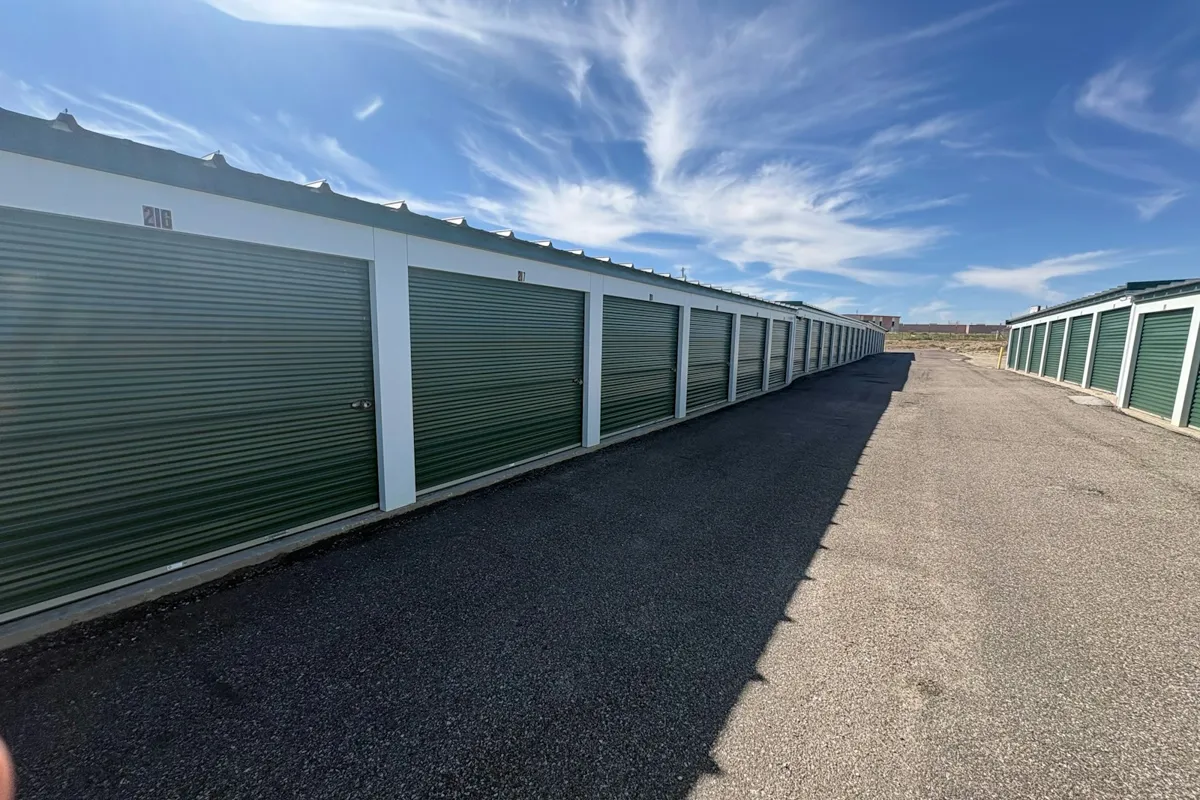
The roll-up door is the light, ribbed kind on storage units and small workshops, with its own spring and a simple latch at the bottom. Rolling grilles, the see-through cousin of the rolling steel door, protect storefronts after hours.
Each one wears differently, and the technician works on all of them: springs, cables, slats and panels, tracks and channels, motors and controls.
A spring hailstorm can leave a wide commercial door dimpled from top to bottom. Cosmetic dents are one thing, but a crease near a hinge or across a slat makes the door bind as it rolls, and one side starts lifting harder than the other until a cable gives out months later.
Then there are the everyday knocks: a box truck backing in a little crooked, a forklift mast catching the bottom panel, a trailer clipping the track. Damaged panels and slats can usually be replaced individually, and a bent track or channel is straightened or swapped, so a single bad morning doesn't mean an entire new door.
A closed metal building in August gets brutally hot up near the roof, right where door motors and their circuit boards are mounted. Heat shortens the life of the electronics, and a board that quits after a hot spell is one of the most common commercial calls in summer.
The sun works on the rubber, too. Bottom seals and weatherstrip bake until they crack and shrink, and then dust, rain and insects come in along the gaps. Fresh seals are a simple fix with an immediate payoff, and for a bay that runs air conditioning, an insulated sectional door can be weighed against the old one as an option on the estimate.
The order is the same whether it is one door or a row of them.
A bay door that won't come down when the shift ends, a storage facility with its main entrance stuck up, or a shop that can't shut out the street jumps ahead of routine work. The opening is closed and secured on the first visit, and if the full fix needs a special part, that part is ordered for a return trip.
Once the building is locked up, the rest of the job is planned around your trading hours rather than in the middle of them.
A storage facility can have dozens of roll-up doors, and each one is opened by a different tenant with a different idea of how hard to yank it. The same failures repeat across a property: springs that have lost their tension, latches that no longer line up, sheets creased by a dolly, and guides pushed out of line.
Rather than one unit at a time, the doors that need attention can be walked in a single visit and written up unit by unit, so the facility manager can approve the urgent ones first and plan the rest.
Plenty of small shops still raise their doors by hand or with a pull chain. When the door is in good shape and balanced, adding a motor is usually straightforward, run from a wall station or a keyed switch, with a manual release kept for power cuts. The springs are looked at first, because a motor is never meant to lift weight the springs have stopped carrying.
Where customers and staff walk under the doors all day, the reversing devices are the part that matters most. A pressure-sensitive strip runs along the door's bottom edge and a pair of eyes watches the doorway; touch the strip or break the beam and the door reverses. If either is damaged or knocked out of line, that repair heads the estimate.
Panel-style overhead doors, slatted rolling steel doors, the ribbed roll-ups used on storage units and small workshops, and see-through rolling grilles.
Not always. A panel or slat creased badly enough to bind is swapped by itself, while purely cosmetic dents can wait, and the estimate keeps the two apart.
Usually. Heat-damaged circuit boards are a common repair, and boards for the common motors travel with the technician. If the motor is near the end of its life, a replacement is written up beside the repair.
As little as possible. A door that leaves the building unsecured is dealt with first, and everything else is booked for a slow period you choose.
In most cases, if the door is sound and balanced. A manual release is always kept so the door can still be opened in an outage.
Yes. Grilles that jam, drag in their channels or refuse to lock are repaired, including the springs in the drum above the opening.
Yes. Mention each door when you call, and each gets its own lines on the estimate.
Yes, and there's no catch. Each door gets its own written lines, and the work starts only when you approve.
We give a two-hour window rather than a day, and we call before setting off. Free throughout Williamson County. The estimate is free either way.
Prefer a voice? Call (512) 642-5436.
Give us the problem. Free estimate, no catch.